
• Link to X
  • Link to LinkedIn
  • Link to Mail
  • ABOUT UI
    • Business Partners
    • Careers
    • Contact Us
    • News & Press
    • Our Team
    • Press Releases
    • Branding Guidelines
  • CONTACT
Uptime Institute Blog
  • Journal
    • Journal Home
    • Executive
    • Operations
    • Design
  • AI Services
    • AI Infrastructure Advisory
  • Tier Certification
    • Overview
    • Design
    • Construction
    • Operations
    • Tier Gap Analysis
    • Prefabricated/Modular
    • Tier Certifications List
  • Professional Services
    • Overview
    • Infrastructure Services
    • Management and Operations Services
    • Energy and Sustainability Services
    • Consulting Services
  • Education
    • Education Framework
    • Course Calendar
    • Competency & Confidence Assessments
    • Private Education
    • Graduate Roster
  • Events
    • Industry Events
    • Leadership Events
    • Network Events
  • Network
    • Overview
    • Network Calendar
    • Network Roster
    • Request Corporate Access
    • Request Guest Access
    • Uptime Network Portal
  • Intelligence
  • Clients
    • Client Stories
  • Resources
    • Data Center Industry Surveys
    • Ebooks
    • Journal Blog
    • Product Datasheets
    • Research & Reports
    • Tier Specification Documents
    • Tools
    • Webinars
  • Click to open the search input field Click to open the search input field Search
  • Menu Menu
Blog - Latest News

AI in data: sorting reality from hallucination

February 20, 2026/in Design, Executive, Operations/by Dr. Rand Talib, Research Analyst, Uptime Institute, rtalib@uptimeinstitute.com

Many people do not use the term artificial intelligence correctly: vendors, investors, and even some operators label everything from basic automation scripts to deep learning controllers as AI. This inflation of the term has commercial and strategic motives. AI branding helps attract funding, creates differentiation in the market, and positions traditional analytics as cutting-edge solutions.

However, this broad usage also breeds confusion and skepticism. Data center operators, uncertain about the level of autonomy or risk they face, often hesitate to implement even safe, deterministic systems.

Many operators remain hesitant to implement AI in their data centers, often citing fears of hallucination — the risk that an AI system might generate false or invented information. Yet not all AI behaves this way, and the term is frequently misapplied. By clarifying the different types of AI, how they vary in capability and reliability, and which pose genuine hallucination risks, operators can better distinguish dependable automation from the marketing-driven “AI-washing” that fuels confusion and obscures real risk.

The spectrum of AI in data centers

AI in data centers spans a broad continuum, from deterministic, data-driven algorithms to advanced systems capable of adaptive or autonomous decision-making. Treating these technologies as a single category obscures important differences in capability, reliability and operational risk. Understanding this spectrum is critical for evaluating what each system can — and cannot — safely automate.

Table 1 compares the different types of AI used in modern data centers.

Table 1 AI types used in data centers
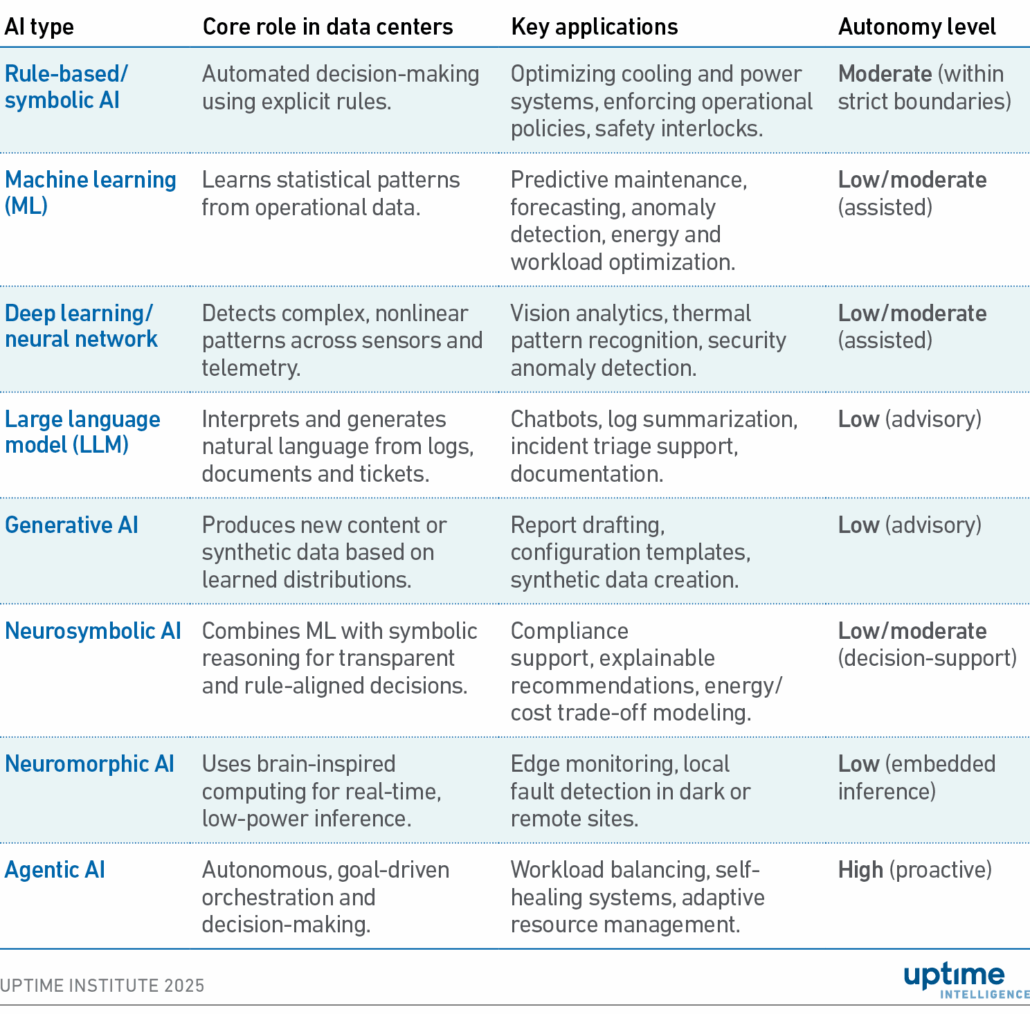
Table: AI types used in data centers

Mislabeling AI: the root of hallucination fears

Across the tech sector, and within data center operations in particular, everything from basic regression models to large transformer networks is labeled as AI. This conflation blurs the operational reality:

  • Predictive and optimization models (ML, neural networks) rely on measurable data and statistical learning. They rarely improvise.
  • Generative and language models (LLMs, GenAI) produce content probabilistically, often without grounding in external data, which creates a risk of fabrication.
  • Agentic AI orchestrates systems and can call on other models (including LLMs) to plan or communicate, but its reliability depends on which components it uses.

This terminological blur feeds operator anxiety. A predictive control loop that tunes chillers based on real-time feedback is not at risk of hallucination, yet many operators equate it with the behavior of chatbots and generative systems. In practice, hallucination is a property of generative AI, not of deterministic automation or data-driven control.

Understanding which AI types can hallucinate, and why, is essential for evaluating their operational reliability. Table 2 below clarifies the differences across major AI categories used in data centers.

Table 2 Hallucination behavior and risks across AI types
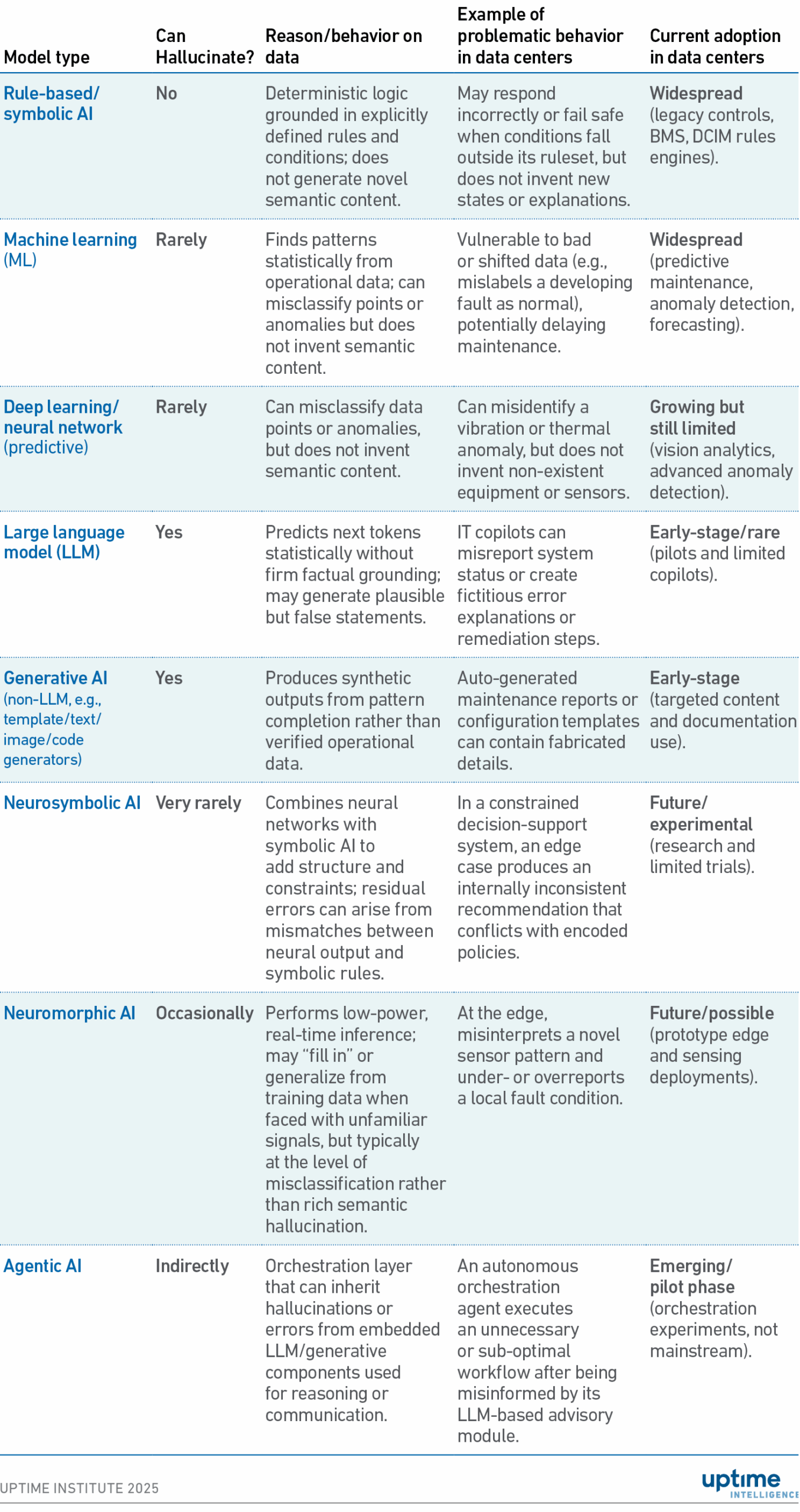
Table: Hallucination behavior and risks across AI types

Managing and mitigating hallucination risks

Operators can apply a focused set of safeguards that keep AI useful while limiting unsafe or fabricated outputs:

  • Constrain generative models to verified, domain‑specific sources such as maintenance manuals, runbooks, building management system (BMS)/data center infrastructure management (DCIM) logs, incident records and approved knowledge articles.
  • Use retrieval‑augmented generation (RAG) so that models base responses on current operational data rather than general training alone.
  • Adopt hybrid architectures that pair LLM copilots with deterministic rule engines or physics‑based digital twins, which can verify or veto proposed actions before they affect live systems.
  • Require human‑in‑the‑loop validation before AI can change configurations, control physical systems, or execute high‑impact runbook steps.
  • Establish clear governance that makes a distinction between “assistive AI” (documentation, recommendations, analysis) and “operational AI” (any system that can directly change configurations or physical infrastructure).
  • Apply strict scoping and access control so more powerful generative or agentic components start in read‑only or advisory modes and follow least‑privilege principles for credentials and APIs.

The Uptime Intelligence View

Much of the data center industry’s caution around AI appears to come from treating it as a single, generative technology rather than a stack of distinct capabilities. In real deployments, predictive models are typically aligned with control and optimization tasks; emerging agentic approaches support orchestrated, multi-step decision flows; and LLMs or other generative systems are best suited for documentation, reasoning support, and advisory use under governance constraints. When these distinctions are made explicit, AI can be a potential enabler of resilient, self‑optimizing facilities and poses less risk of becoming a direct threat to uptime.


Share this:

  • Share on Facebook (Opens in new window) Facebook
  • Share on X (Opens in new window) X
  • Share on LinkedIn (Opens in new window) LinkedIn
  • Share on Reddit (Opens in new window) Reddit
  • Share on WhatsApp (Opens in new window) WhatsApp
  • Email a link to a friend (Opens in new window) Email
Tags: AI, artificial intelligence, Data Center, digital Infrastructure
https://journal.uptimeinstitute.com/wp-content/uploads/2026/02/AI-in-data-sorting-reality-from-hallucination-featured.jpg 540 1030 Dr. Rand Talib, Research Analyst, Uptime Institute, rtalib@uptimeinstitute.com https://journal.uptimeinstitute.com/wp-content/uploads/2022/12/uptime-institute-logo-r_240x88_v2023-with-space.png Dr. Rand Talib, Research Analyst, Uptime Institute, rtalib@uptimeinstitute.com2026-02-20 15:00:002026-02-19 12:13:09AI in data: sorting reality from hallucination
You might also like
EU battery regulations: what do the new rules mean? EU battery regulations: what do the new rules mean?
emert-cover-photo Data Center Facility Owners See Modules as Efficient Way to Deploy Capital
AWS price cuts: is serverless gaining momentum? AWS price cuts: is serverless gaining momentum?
AI’s growth calls for useful IT efficiency metrics AI’s growth calls for useful IT efficiency metrics
Asset utilization drives cloud repatriation economics Asset utilization drives cloud repatriation economics
Neoclouds: a cost-effective AI infrastructure alternative Neoclouds: a cost-effective AI infrastructure alternative
Critical Infrastructrure Innovation in 2021 A Surge of Innovation
Quantum Computing Quantum computing is not a panacea yet

Content Categories

  • Journal Home
  • Executive
  • Operations
  • Design

Subscribe to Journal via Email

Enter your email address to subscribe to Uptime Institute Journal and receive notifications of new articles by email.

  • Recent

Tags

Accredited Tier Designer (9) AI (22) artificial intelligence (17) ATD (10) Carbon Emissions (7) Climate Change (13) Cloud (23) Cloud Computing (17) Cloud Costs (15) Cloud Infrastructure (29) Cloud Migration (8) Colocation (7) cooling (9) Data Center (253) Data Center Availability (40) Data Center Cooling (13) Data Center Design (45) Data Center Disaster Recovery (7) Data Center Energy Efficiency (34) Data Center Facilities Management (43) Data Center Operations (66) data center power (8) Data Center Staffing (18) DCIM (9) digital Infrastructure (118) energy (8) Energy Efficiency (38) Environmental Sustainability (18) IT (7) IT Efficiency (16) IT Outages (10) M&O (6) outages (11) Public Cloud (7) PUE (10) Regulations (24) Resiliency (9) security (7) Sustainability (34) Sustainability Reporting (7) Tier Certification (26) Tier Certification Constructed Facility (16) Uptime Institute FORCSS (6) Uptime Institute Network (13) Uptime Institute Symposium (6)
© 2014-2025 Uptime Institute, LLC All rights reserved.
  • Link to X
  • Link to LinkedIn
  • Link to Mail
Link to: AI and cooling: toward more automation Link to: AI and cooling: toward more automation AI and cooling: toward more automationAI and cooling: toward more automation Link to: As emissions soar, operators look to carbon capture Link to: As emissions soar, operators look to carbon capture As emissions soar, operators look to carbon captureAs emissions soar, operators look to carbon capture
Scroll to top Scroll to top Scroll to top