• Link to X
  • Link to LinkedIn
  • Link to Mail
  • ABOUT UI
    • Business Partners
    • Careers
    • Contact Us
    • News & Press
    • Our Team
    • Press Releases
    • Branding Guidelines
  • CONTACT
Uptime Institute Blog
  • Journal
    • Journal Home
    • Executive
    • Operations
    • Design
  • AI Services
    • AI Infrastructure Advisory
  • Tier Certification
    • Overview
    • Design
    • Construction
    • Operations
    • Tier Gap Analysis
    • Prefabricated/Modular
    • Tier Certifications List
  • Professional Services
    • Overview
    • Infrastructure Services
    • Management and Operations Services
    • Energy and Sustainability Services
    • Consulting Services
  • Education
    • Course Details
    • Course Calendar
    • Competency & Confidence Assessments
    • Private Education
    • Graduate Roster
  • Events
    • Industry Events
    • Leadership Events
    • Network Events
  • Network
    • Overview
    • Network Calendar
    • Network Roster
    • Request Corporate Access
    • Request Guest Access
    • Uptime Network Portal
  • Intelligence
  • Clients
    • Client Stories
  • Resources
    • Data Center Industry Surveys
    • Ebooks
    • Journal Blog
    • Product Datasheets
    • Research & Reports
    • Tier Specification Documents
    • Tools
    • Webinars
  • Click to open the search input field Click to open the search input field Search
  • Menu Menu
Blog - Latest News
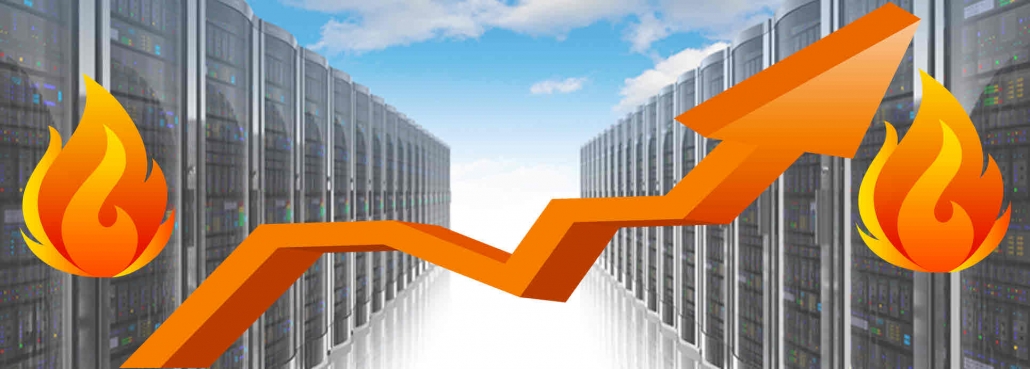
Datacenter fire frequency trends

Datacenter Fire Frequency

April 5, 2021/in Design, Executive, Operations/by Andy Lawrence, Executive Director of Research, Uptime Institute, alawrence@uptimeinstitute.com

The catastrophic fire that occurred at OVHcloud’s SBG2 data center in Strasbourg, France (see last week’s blog about it) has led many operators to question their vulnerability to fires.

Fires at data centers are a constant concern, but are rare. In almost all cases of data center fire, the source is quickly located, the equipment isolated, and damage contained to a small area.

Uptime Institute’s database of abnormal incidents, which documents over 8,000 incidents shared by members since its inception in 1994, records 11 fires in data centers — less than 0.5 per year. All of these were successfully contained, causing minimal damage/disruption.

A separate Uptime Institute database of publicly recorded incidents around the world — which includes only those that receive public/media attention — also shows fires are rare, with outages often caused by fire suppression equipment.
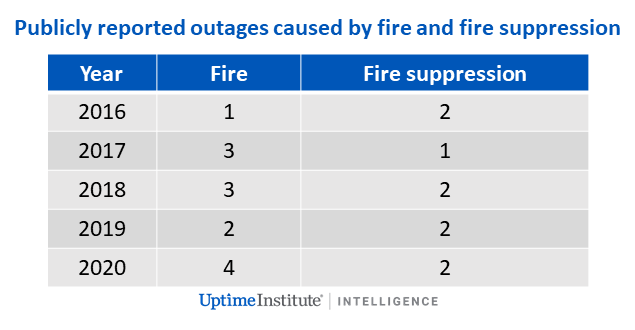
One or two of these fires have been serious and have led to some destruction of equipment and data. However, the data centers or communications rooms involved have been small, with minimal long-term disruption.

The majority of incidents begin and end in the electrical room (although “people doing dumb things” — such as overloading power strips or working with open flames near flammable materials — is also a cause, says Uptime Institute Chief Technical Officer Chris Brown). Faults in uninterruptible power supplies can create heat and smoke and can require that the equipment be immediately isolated, but the risk rarely goes beyond this, due the lack of nearby combustive materials.

If batteries are nearby, they can catch fire and will burn until the fuel is consumed — which can take some time. Lithium-ion batteries, which are commonly perceived as a fire risk, contain internal monitoring at the cell level, which cuts the battery power if heating occurs.

In recent years (before OVHcloud Strasbourg), accidental discharge of fire suppression systems, especially high pressure clean agent gas systems, has actually caused significantly more serious disruption than fires, with some banking and financial trading data centers affected by this issue. Fires near a data center, or preventative measures taken to reduce the likelihood of forest fires, have also led to some data center disruption (not included in the numbers reported above).

Responsibility for fire regulation is covered by the local AHJ (authority having jurisdiction), and requirements are usually strict. But rules may be stricter for newer facilities, so good operational management is critical for older data centers.

Uptime Institute advises that all data centers use VESDA (very early smoke detection apparatus) systems and maintain appropriate fire barriers and separation of systems. Well-maintained water sprinkler or low pressure clean agent fire suppression systems are preferred. Risk assessments, primarily aimed at reducing the likelihood of outages, will also pick up obvious issues with these systems.

The Uptime Tier IV certification requires 1 hour fire-rated partitions between complementary critical systems. This is to help ensure a fire in one area does not immediately shut down a data center. It does assume proper fire suppression in the facility.
Share this:

  • Share on Facebook (Opens in new window) Facebook
  • Share on X (Opens in new window) X
  • Share on LinkedIn (Opens in new window) LinkedIn
  • Share on Reddit (Opens in new window) Reddit
  • Share on WhatsApp (Opens in new window) WhatsApp
  • Email a link to a friend (Opens in new window) Email
Tags: Data Center, fire suppression
https://journal.uptimeinstitute.com/wp-content/uploads/2021/04/fire3.jpg 692 1932 Andy Lawrence, Executive Director of Research, Uptime Institute, alawrence@uptimeinstitute.com https://journal.uptimeinstitute.com/wp-content/uploads/2022/12/uptime-institute-logo-r_240x88_v2023-with-space.png Andy Lawrence, Executive Director of Research, Uptime Institute, alawrence@uptimeinstitute.com2021-04-05 08:26:002025-10-30 13:30:46Datacenter Fire Frequency
You might also like
Artificial Intelligence in the Data Center2019, Getty Artificial Intelligence in the Data Center: Myth versus Reality
Are data centers to blame for power quality issues? Are data centers to blame for power quality issues?
DCIM past and present: what’s changed? DCIM past and present: what’s changed?
Sacrifice speed to cut cloud carbon and costs Sacrifice speed to cut cloud carbon and costs
AI’s growth calls for useful IT efficiency metrics AI’s growth calls for useful IT efficiency metrics
Is concern over cloud and third-party outages increasing? Is concern over cloud and third-party outages increasing?
Cloud migrations to face closer scrutiny Cloud migrations to face closer scrutiny
Global PUEs — are they going anywhere? Global PUEs — are they going anywhere?

Content Categories

  • Journal Home
  • Executive
  • Operations
  • Design

Subscribe to Journal via Email

Enter your email address to subscribe to Uptime Institute Journal and receive notifications of new articles by email.

  • Recent

Tags

Accredited Tier Designer (9) AI (21) artificial intelligence (16) ATD (10) Carbon Emissions (7) Climate Change (13) Cloud (22) Cloud Computing (17) Cloud Costs (15) Cloud Infrastructure (29) Cloud Migration (8) Colocation (6) cooling (9) Data Center (252) Data Center Availability (40) Data Center Cooling (13) Data Center Design (45) Data Center Disaster Recovery (7) Data Center Energy Efficiency (34) Data Center Facilities Management (43) Data Center Operations (66) data center power (8) Data Center Staffing (18) DCIM (9) digital Infrastructure (117) energy (8) Energy Efficiency (38) Environmental Sustainability (18) IT (7) IT Efficiency (16) IT Outages (10) M&O (6) outages (11) Public Cloud (7) PUE (10) Regulations (24) Resiliency (9) security (7) Sustainability (34) Sustainability Reporting (7) Tier Certification (26) Tier Certification Constructed Facility (16) Uptime Institute FORCSS (6) Uptime Institute Network (13) Uptime Institute Symposium (6)
© 2014-2025 Uptime Institute, LLC All rights reserved.
  • Link to X
  • Link to LinkedIn
  • Link to Mail
Link to: Learning from the OVHcloud data center fire Link to: Learning from the OVHcloud data center fire Learning from the OVHcloud data center fire Link to: Data center insecurity: Online exposure threatens critical systems Link to: Data center insecurity: Online exposure threatens critical systems Data Center SecurityData center insecurity: Online exposure threatens critical systems
Scroll to top Scroll to top Scroll to top