
• Link to X
  • Link to LinkedIn
  • Link to Mail
  • ABOUT UI
    • Business Partners
    • Careers
    • Contact Us
    • News & Press
    • Our Team
    • Press Releases
    • Branding Guidelines
  • CONTACT
Uptime Institute Blog
  • Journal
    • Journal Home
    • Executive
    • Operations
    • Design
  • AI Services
    • AI Infrastructure Advisory
    • AI Custom Support
  • Tier Certification
    • Overview
    • Design
    • Construction
    • Operations
    • Tier Gap Analysis
    • Prefabricated/Modular
    • Tier Certifications List
  • Professional Services
    • Overview
    • Infrastructure Services
    • Management and Operations Services
    • Energy and Sustainability Services
    • Consulting Services
  • Education
    • Course Details
    • Course Calendar
    • Competency & Confidence Assessments
    • Private Education
    • Graduate Roster
  • Events
    • Industry Events
    • Leadership Events
    • Network Events
  • Network
    • Overview
    • Network Calendar
    • Network Roster
    • Request Corporate Access
    • Request Guest Access
    • Uptime Network Portal
  • Intelligence
  • Clients
    • Client Stories
  • Resources
    • Data Center Industry Surveys
    • Ebooks
    • Journal Blog
    • Product Datasheets
    • Research & Reports
    • Tier Specification Documents
    • Tools
    • Webinars
  • Click to open the search input field Click to open the search input field Search
  • Menu Menu
Blog - Latest News
The ultimate liquid cooling: heat rejection into water

The ultimate liquid cooling: heat rejection into water

June 29, 2022/in Design, Executive, Operations/by Jacqueline Davis, Research Analyst, Uptime Institute, jdavis@uptimeinstitute.com

Uptime Institute’s data on power usage effectiveness (PUE) is a testament to the progress the data center industry has made in energy efficiency over the past 10 years. However, global average PUEs have been largely stalling at close to 1.6 since 2018, with only marginal gains. This makes sense: for the average figure to show substantial improvement, most facilities would require financially unviable overhauls to their cooling systems to achieve notably better efficiencies, while modern builds already operate near the physical limits of air cooling.

A growing number of operators are looking to direct liquid cooling (DLC) for the next leap in infrastructure efficiency. But a switch to liquid cooling at scale involves operational and supply chain complexities that challenge even the most resourceful technical organizations. Uptime is aware of only one major operator that runs DLC as standard: French hosting and cloud provider OVHcloud, which is an outlier with a vertically integrated infrastructure using custom in-house water cold plate and server designs.

When it comes to the use of liquid cooling, an often-overlooked part of the cooling infrastructure is heat rejection. Rejecting heat into the atmosphere is a major source of inefficiencies, manifesting not only in energy use, but also in capital costs and in large reserves of power for worst case (design day) cooling needs.

A small number of data centers have been using water features as heat sinks successfully for some years. Instead of eliminating heat through water towers, air-cooled chillers or other means that rely on ambient air, some facilities use the closed chilled water loop, which rejects heat through a heat exchanger that’s cooled by an open loop of water. These cooling designs using water heat sinks extend the benefits of water’s thermal properties from heat transport inside the data center to the rejection of heat outside the facilities.
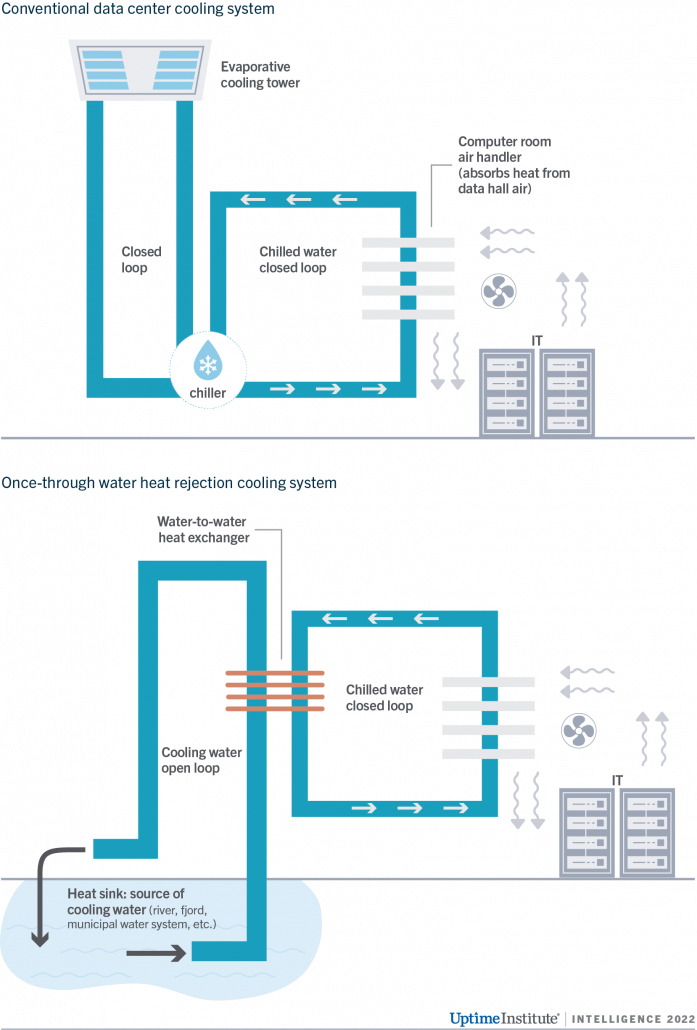
Schematic of a data center once-through system
Figure 1. Schematic of a data center once-through system

The idea of using water for heat rejection, of course, is not new. Known as once-through cooling, these systems are used extensively in thermoelectric power generation and manufacturing industries for their efficiency and reliability in handling large heat loads. Because IT infrastructures are relatively smaller and tend to cluster around population centers, which in turn tend to be situated near water, Uptime considers the approach to have wide geographical applicability in future data center construction projects.

Uptime’s research has identified more than a dozen data center sites, some operated by global brands, that use a water feature as a heat sink. All once-through cooling designs use some custom equipment — there are currently no off-the-shelf designs that are commercially available for data centers. While the facilities we studied vary in size, location and some engineering choices, there are some commonalities between the projects.

Operators we’ve interviewed for the research (all of them colocation providers) considered their once-through cooling projects to be both a technical and a business success, achieving strong operational performance and attracting customers. The energy price crisis that started in 2021, combined with a corporate rush to claim strong sustainability credentials, reportedly boosted the level of return on these investments past even optimistic scenarios.

Rejecting heat into bodies of water allows for stable PUEs year-round, meaning that colocation providers can serve a larger IT load from the same site power envelope. Another benefit is the ability to lower computer room temperatures, for example, 64°F to 68°F (18°C to 20°C) for “free”: this does not come with a PUE penalty. Low-temperature air supply helps operators minimize IT component failures and accommodate future high-performance servers with sufficient cooling. If the water feature is naturally flowing or replenished, operators also eliminate the need for chillers or other large cooling systems from their infrastructure, which would otherwise be required as backup.

Still, that these favorable outcomes outweigh the required investments were far from certain during design and construction, as all undertaking involved nontrivial engineering efforts and associated costs. Committed sponsorship from senior management was critical for these projects to be given the green light and to overcome any unexpected difficulties. Encouraged by the positive experience of the facilities we studied, Uptime expects once-through cooling to gather more interest in the future. A more mature market for these designs will factor into siting decisions, as well as jurisdictional permitting requirements as a proxy for efficiency and sustainability. Once-through systems will also help to maximize the energy efficiency benefits of future DLC rollouts through “free” low-temperature operations, creating an end-to-end liquid cooling infrastructure.

By: Jacqueline Davis, Research Analyst, Uptime Institute and Daniel Bizo, Research Director, Uptime Institute


Share this:

  • Share on Facebook (Opens in new window) Facebook
  • Share on X (Opens in new window) X
  • Share on LinkedIn (Opens in new window) LinkedIn
  • Share on Reddit (Opens in new window) Reddit
  • Share on WhatsApp (Opens in new window) WhatsApp
  • Email a link to a friend (Opens in new window) Email
Tags: Data Center, Data Center Efficiency, digital Infrastructure, DLC, Emerging Technologies, Environmental Sustainability, Heat Rejection, Liquid Cooling, Operations & Procedures
https://journal.uptimeinstitute.com/wp-content/uploads/2022/06/Ultimate-liquid-cooling-featured.jpg 628 1200 Jacqueline Davis, Research Analyst, Uptime Institute, jdavis@uptimeinstitute.com https://journal.uptimeinstitute.com/wp-content/uploads/2022/12/uptime-institute-logo-r_240x88_v2023-with-space.png Jacqueline Davis, Research Analyst, Uptime Institute, jdavis@uptimeinstitute.com2022-06-29 07:00:002022-06-17 15:22:44The ultimate liquid cooling: heat rejection into water
You might also like
Fire Suppression Systems Bring Unexpected Risk
Data center cost Data Center Cost Myths: SCALE
Data center management software is evolving — at last Data center management software is evolving — at last
First signs of federal data center reporting mandates appear in US First signs of federal data center reporting mandates appear in US
UI @ 2020 Common Factors for IT venue selection (Choosing In-house or Outsource)
Learning from the OVHcloud data center fire
Cooling to play a more active role in IT performance and efficiency Cooling to play a more active role in IT performance and efficiency
AI power fluctuations strain both budgets and hardware AI power fluctuations strain both budgets and hardware

Content Categories

  • Journal Home
  • Executive
  • Operations
  • Design

Subscribe to Journal via Email

Enter your email address to subscribe to Uptime Institute Journal and receive notifications of new articles by email.

  • Recent

Tags

Accredited Tier Designer (9) AI (20) artificial intelligence (15) ATD (10) Carbon Emissions (7) Climate Change (13) Cloud (22) Cloud Computing (17) Cloud Costs (15) Cloud Infrastructure (29) Cloud Migration (8) Colocation (6) cooling (9) Data Center (251) Data Center Availability (40) Data Center Cooling (13) Data Center Design (45) Data Center Disaster Recovery (7) Data Center Energy Efficiency (34) Data Center Facilities Management (43) Data Center Operations (66) data center power (8) Data Center Staffing (18) DCIM (9) digital Infrastructure (116) energy (8) Energy Efficiency (37) Environmental Sustainability (18) IT (7) IT Efficiency (16) IT Outages (10) M&O (6) outages (11) Public Cloud (7) PUE (9) Regulations (24) Resiliency (9) security (7) Sustainability (34) Sustainability Reporting (7) Tier Certification (26) Tier Certification Constructed Facility (16) Uptime Institute FORCSS (6) Uptime Institute Network (13) Uptime Institute Symposium (6)
© 2014-2025 Uptime Institute, LLC All rights reserved.
  • Link to X
  • Link to LinkedIn
  • Link to Mail
Link to: Cloud SLAs punish, not compensate Link to: Cloud SLAs punish, not compensate Cloud SLAs punish, not compensateCloud SLAs punish, not compensate Link to: Direct liquid cooling: pressure is rising but constraints remain Link to: Direct liquid cooling: pressure is rising but constraints remain Direct liquid cooling (DLC): pressure is rising but constraints remainDirect liquid cooling: pressure is rising but constraints remain
Scroll to top Scroll to top Scroll to top