

• Link to X
  • Link to LinkedIn
  • Link to Mail
  • ABOUT UI
    • Business Partners
    • Careers
    • Contact Us
    • News & Press
    • Our Team
    • Press Releases
    • Branding Guidelines
  • CONTACT
Uptime Institute Blog
  • Journal
    • Journal Home
    • Executive
    • Operations
    • Design
  • AI Services
    • AI Infrastructure Advisory
  • Tier Certification
    • Overview
    • Design
    • Construction
    • Operations
    • Tier Gap Analysis
    • Prefabricated/Modular
    • Tier Certifications List
  • Professional Services
    • Overview
    • Infrastructure Services
    • Management and Operations Services
    • Energy and Sustainability Services
    • Consulting Services
  • Education
    • Education Framework
    • Course Calendar
    • Competency & Confidence Assessments
    • Private Education
    • Graduate Roster
  • Events
    • Industry Events
    • Leadership Events
    • Network Events
  • Network
    • Overview
    • Network Calendar
    • Network Roster
    • Request Corporate Access
    • Request Guest Access
    • Uptime Network Portal
  • Intelligence
  • Clients
    • Client Stories
  • Resources
    • Data Center Industry Surveys
    • Ebooks
    • Journal Blog
    • Product Datasheets
    • Research & Reports
    • Tier Specification Documents
    • Tools
    • Webinars
  • Click to open the search input field Click to open the search input field Search
  • Menu Menu
Blog - Latest News
Direct liquid cooling (DLC): pressure is rising but constraints remain

Direct liquid cooling: pressure is rising but constraints remain

July 6, 2022/in Design, Executive, Operations/by Daniel Bizo, Research Director, Uptime Institute Intelligence, dbizo@uptimeinstitute.com

Direct liquid cooling (DLC) is a collection of techniques that removes heat by circulating a coolant to IT electronics. Even though the process is far more efficient than using air, the move to liquid cooling has been largely confined to select applications in high-performance computing to cool extreme high-density IT systems. There are a few examples of operators using DLC at scale, such as OVHcloud in France, but generally DLC continues to be an exception to the air cooling norm. In a survey of enterprise data center operators in the first quarter of 2022, Uptime Institute found that approximately one in six currently uses DLC (see Figure 1).
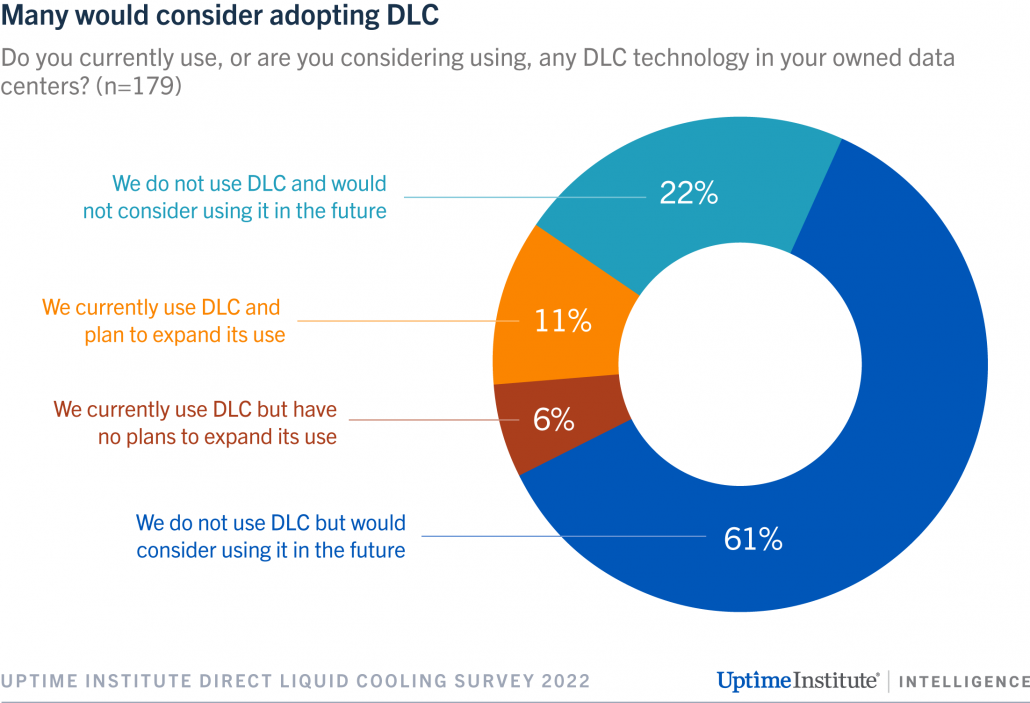
diagram: Many would consider adopting DLC
Figure 1 Many would consider adopting DLC

Uptime Institute Intelligence believes this balance will soon start shifting toward DLC. Renewed market activity has built up around DLC in anticipation of demand, offering a broader set of DLC systems than ever before. Applications that require high-density infrastructure, such as high-performance technical computing, big data analytics and the rapidly emerging field of deep neural networks, are becoming larger and more common. In addition, the pressure on operators to further improve efficiency and sustainability is building, as practical efficiency gains from air cooling have run their course. DLC offers the potential for a step change in these areas.

Yet, it is the evolution of data center IT silicon that will likely start pushing operators toward DLC en masse. High-density racks can be handled tactically and sustainability credentials can be fudged but escalating processor and server power, together with the tighter temperature limits that come with them, will gradually render air cooling impractical in the second half of this decade.

Air cooling will be unable to handle future server developments without major compromises — such as larger heat sinks, higher fan power or (worse still) the need to lower air temperature. Uptime believes that organizations that cannot handle these next-generation systems because of their cooling requirements will compromise their IT performance — and likely their efficiency— compared with organizations that embrace them (see Moore’s law resumes — but not for all).

While the future need for scaled-up DLC deployments seems clear, there are technical and business complexities. At the root of the challenges involved is the lack of standards within the DLC market. Unlike air cooling, where air acts both as the standard cooling medium and as the interface between facilities and IT, there is no comparable standard coolant or line of demarcation for DLC. Efforts to create some mechanical interface standards, notably within the Open Compute Project and more recently by Intel, will take years to materialize in product form.

However, the DLC systems that are currently available have evolved significantly in recent years and have become easier to adopt, install and operate. A growing number of DLC production installations in live environments are providing vendors with more data to inform product development in terms of reliability, ease of use and material compatibility. Crucially, a patchwork of partnerships between IT vendors, DLC technology providers and system integrators is growing to make liquid-cooled servers more readily available.

Uptime has identified six commercially available categories of DLC systems (three cold plates and three immersion) but expects additional categories to develop in the near future:

  • Water cold plates.
  • Single-phase dielectric cold plates.
  • Two-phase dielectric cold plates.
  • Chassis immersion.
  • Single-phase immersion.
  • Two-phase immersion.

There are more than a dozen specialist vendors that actively develop DLC products, typically focusing on one of the above system categories, and numerous other ones have the capability to do so. Each category has a distinct profile of technical and business trade-offs. We exclude other systems that bring liquid to the rack, such as rear-door heat exchangers, due to their reliance on air as the medium to transfer heat from IT electronics to the facility’s cooling infrastructure. This is not an arbitrary distinction: there are major differences in the technical and business characteristics of these systems.

Uptime’s research indicates that most enterprises are open to making the change to DLC, and indeed project considerable adoption of DLC in the coming years. While the exact profile of the uptake of DLC cannot be realistically modeled, Uptime considers there to be strong evidence for a general shift to DLC. The pace of adoption, however, will likely be constrained by a fractured market of suppliers and vendors, organizational inertia — and a lack of formal standards and components.

Check out this DLC webinar for more in-depth insights on the state of direct liquid cooling in the digital infrastructure sector. The full Intelligence report “The coming era of direct liquid cooling: it’s when, not if” is available exclusively to Uptime Institute members. Learn more about Uptime Institute Membership and request a free guest trial here.

Share this:

  • Share on Facebook (Opens in new window) Facebook
  • Share on X (Opens in new window) X
  • Share on LinkedIn (Opens in new window) LinkedIn
  • Share on Reddit (Opens in new window) Reddit
  • Share on WhatsApp (Opens in new window) WhatsApp
  • Email a link to a friend (Opens in new window) Email
Tags: Data Center, Data Center Efficiency, digital Infrastructure, DLC, Emerging Technologies, Environmental Sustainability, Liquid Cooling, Operations & Procedures
https://journal.uptimeinstitute.com/wp-content/uploads/2022/06/Direct-liquid-cooling-pressure-is-rising-but-constraints-remain-featured.jpg 628 1200 Daniel Bizo, Research Director, Uptime Institute Intelligence, dbizo@uptimeinstitute.com https://journal.uptimeinstitute.com/wp-content/uploads/2022/12/uptime-institute-logo-r_240x88_v2023-with-space.png Daniel Bizo, Research Director, Uptime Institute Intelligence, dbizo@uptimeinstitute.com2022-07-06 08:00:002025-10-28 12:25:48Direct liquid cooling: pressure is rising but constraints remain
You might also like
Climate change: More operators prepare to weather the storms Climate change: More operators prepare to weather the storms
emert-cover-photo Data Center Facility Owners See Modules as Efficient Way to Deploy Capital
AWS price cuts: is serverless gaining momentum? AWS price cuts: is serverless gaining momentum?
The Energy Efficiency Directive: requirements come into focus The Energy Efficiency Directive: requirements come into focus
AI’s growth calls for useful IT efficiency metrics AI’s growth calls for useful IT efficiency metrics
24x7 carbon-free energy (part two): getting to 100% 24×7 carbon-free energy (part two): getting to 100%
2020 Will the pandemic accelerate the move to public cloud?
Myths and Misconceptions Regarding the Uptime Institute’s Tier Certification System

Content Categories

  • Journal Home
  • Executive
  • Operations
  • Design

Subscribe to Journal via Email

Enter your email address to subscribe to Uptime Institute Journal and receive notifications of new articles by email.

  • Recent

Tags

Accredited Tier Designer (9) AI (22) artificial intelligence (17) ATD (10) Carbon Emissions (7) Climate Change (13) Cloud (23) Cloud Computing (17) Cloud Costs (15) Cloud Infrastructure (29) Cloud Migration (8) Colocation (7) cooling (9) Data Center (253) Data Center Availability (40) Data Center Cooling (13) Data Center Design (45) Data Center Disaster Recovery (7) Data Center Energy Efficiency (34) Data Center Facilities Management (43) Data Center Operations (66) data center power (8) Data Center Staffing (18) DCIM (9) digital Infrastructure (118) energy (8) Energy Efficiency (38) Environmental Sustainability (18) IT (7) IT Efficiency (16) IT Outages (10) M&O (6) outages (11) Public Cloud (7) PUE (10) Regulations (24) Resiliency (9) security (7) Sustainability (34) Sustainability Reporting (7) Tier Certification (26) Tier Certification Constructed Facility (16) Uptime Institute FORCSS (6) Uptime Institute Network (13) Uptime Institute Symposium (6)
© 2014-2025 Uptime Institute, LLC All rights reserved.
  • Link to X
  • Link to LinkedIn
  • Link to Mail
Link to: The ultimate liquid cooling: heat rejection into water Link to: The ultimate liquid cooling: heat rejection into water The ultimate liquid cooling: heat rejection into waterThe ultimate liquid cooling: heat rejection into water Link to: Cloud price increases damage trust Link to: Cloud price increases damage trust Cloud price increases damage trustCloud price increases damage trust
Scroll to top Scroll to top Scroll to top