• Link to X
  • Link to LinkedIn
  • Link to Mail
  • ABOUT UI
    • Business Partners
    • Careers
    • Contact Us
    • News & Press
    • Our Team
    • Press Releases
    • Branding Guidelines
  • CONTACT
Uptime Institute Blog
  • Journal
    • Journal Home
    • Executive
    • Operations
    • Design
  • AI Services
    • AI Infrastructure Advisory
  • Tier Certification
    • Overview
    • Design
    • Construction
    • Operations
    • Tier Gap Analysis
    • Prefabricated/Modular
    • Tier Certifications List
  • Professional Services
    • Overview
    • Infrastructure Services
    • Management and Operations Services
    • Energy and Sustainability Services
    • Consulting Services
  • Education
    • Education Framework
    • Course Calendar
    • Competency & Confidence Assessments
    • Private Education
    • Graduate Roster
  • Events
    • Industry Events
    • Leadership Events
    • Network Events
  • Network
    • Overview
    • Network Calendar
    • Network Roster
    • Request Corporate Access
    • Request Guest Access
    • Uptime Network Portal
  • Intelligence
  • Clients
    • Client Stories
  • Resources
    • Data Center Industry Surveys
    • Ebooks
    • Journal Blog
    • Product Datasheets
    • Research & Reports
    • Tier Specification Documents
    • Tools
    • Webinars
  • Click to open the search input field Click to open the search input field Search
  • Menu Menu
Blog - Latest News
Data Center Outage Severity Rating SystemUptime Institute, 2019

Comparing the severity of IT service outages: Uptime Institute’s Outage Severity Rating

May 8, 2019/in Design, Executive, Operations/by Andy Lawrence, Executive Director of Research, Uptime Institute, alawrence@uptimeinstitute.com

Avoiding IT service outages is a big concern for any operator or service provider, especially one providing a business-critical service.  But when an outage does occur, the business impact can vary from “barely noticeable” to “huge and expensive.”  Anticipating and modeling the impact of a service interruption should be a part of incident planning and is key to determining the level of investment that should be made to reduce incidents and their impact.

In recent years, Uptime Institute has been collecting data about service outages, including the costs, the consequences and, most notably, the most common causes.  One of our findings is that organizations often don’t collect full financial data about the impact of outages, or if they do, it might take months for these to become apparent. Many of the costs are hidden, even if the outcry from managers and even non-paying customers is most certainly not.  But cost is not a proxy for impact: even a relatively short and inexpensive outage at a big, consumer-facing service provider can attract negative, national headlines.

Another clear trend, now that so many applications are distributed and interlinked, is that “outages” can often be partial, affecting users in different ways. This has, in some cases, enabled some major operators to claim very impressive availability figures in spite of poor customer experience. Their argument: Just because a service is slow or can’t perform some functions doesn’t mean it is “down.”

To give managers a shorthand way to talk about the impact of a service outage, Uptime Institute developed the Outage Severity Rating (below). The rating is not scientific and might be compared to the internationally used Beaufort Scale, which describes how various wind speeds are experienced on land and sea.
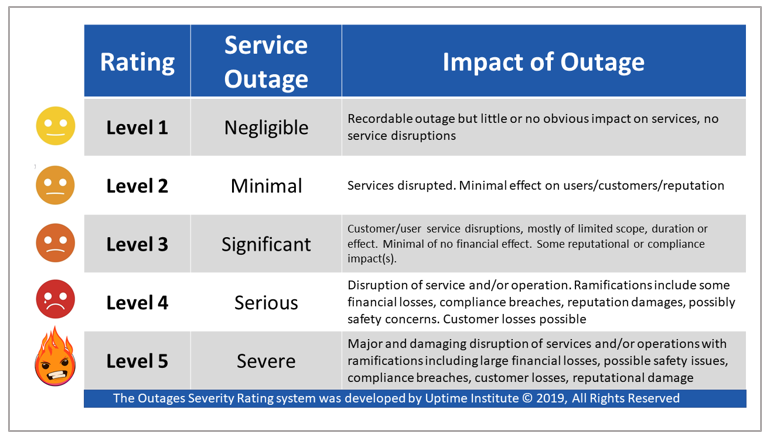
The Uptime Institute Outage Severity Rating describes the business/service impact of an IT service interruption, regardless of the cause.

By applying this scale to widely reported outages from 2016-2018, Uptime Institute tracked 11 “Severe” Category 5 outages and 46 “Serious” Category 4 outages. Of these 11 severe outages, no fewer than five occurred at airlines. In each case, multi-million-dollar losses occurred, as flights were cancelled and travelers stranded. Compensation was paid, and negative headlines ensued.

Analysis suggests both obvious and less obvious reasons why airlines were hit so hard: the obvious one is that airlines are not only highly dependent on IT for almost all elements of the operations, but also that the impact of disruption is immediate and expensive. Less obviously, many airlines have been disrupted by low cost competition and forced to “do more with less” in the field of IT. This leads to errors and over-thrifty outsourcing, and it makes incidents more likely.

If we consider Categories 4 and 5 together, the banking and financial services sector is the most over-weighted. For this sector, outage causes varied widely, and in some cases, cost cutting was a factor. More commonly, the real challenge was simply managing complexity and recovering from failures fast enough to reduce the impact.

——————————————————————————–

Members of Uptime Institute Network experience HALF of the incidents that cause these type of service disruptions. Members share a wealth of experiences with their peers from some of the largest companies in the world. Membership instills a primary consciousness about operational efficiency and best practices which can be put into action everyday.  For membership information click here.

Share this:

  • Share on Facebook (Opens in new window) Facebook
  • Share on X (Opens in new window) X
  • Share on LinkedIn (Opens in new window) LinkedIn
  • Share on Reddit (Opens in new window) Reddit
  • Share on WhatsApp (Opens in new window) WhatsApp
  • Email a link to a friend (Opens in new window) Email
Tags: Data Center, Data Center Disaster Recovery, Data Center Operations, Outage
https://journal.uptimeinstitute.com/wp-content/uploads/2019/04/Outage-red-image.jpg 520 1371 Andy Lawrence, Executive Director of Research, Uptime Institute, alawrence@uptimeinstitute.com https://journal.uptimeinstitute.com/wp-content/uploads/2022/12/uptime-institute-logo-r_240x88_v2023-with-space.png Andy Lawrence, Executive Director of Research, Uptime Institute, alawrence@uptimeinstitute.com2019-05-08 09:00:322025-11-12 12:32:12Comparing the severity of IT service outages: Uptime Institute’s Outage Severity Rating
You might also like
Looking for the x-factor in data center efficiency Looking for the x-factor in data center efficiency
ATD Interview: Elie Siam, Pierre Dammous & Partners
Improving Performance in Ever-Changing Mission-Critical IT Infrastructures
Water is local: generalities do not apply Water is local: generalities do not apply
Mixed resiliency at the edge Mixed resiliency at the edge
Self-contained liquid cooling: the low-friction option Self-contained liquid cooling: the low-friction option
Vertiv’s DCIM ambitions wither on Trellis’ demise Vertiv’s DCIM ambitions wither on Trellis’ demise
Putting DCIM to Work for You

Content Categories

  • Journal Home
  • Executive
  • Operations
  • Design

Subscribe to Journal via Email

Enter your email address to subscribe to Uptime Institute Journal and receive notifications of new articles by email.

  • Recent

Tags

Accredited Tier Designer (9) AI (22) artificial intelligence (17) ATD (10) Carbon Emissions (7) Climate Change (13) Cloud (23) Cloud Computing (17) Cloud Costs (15) Cloud Infrastructure (29) Cloud Migration (8) Colocation (7) cooling (9) Data Center (253) Data Center Availability (40) Data Center Cooling (13) Data Center Design (45) Data Center Disaster Recovery (7) Data Center Energy Efficiency (34) Data Center Facilities Management (43) Data Center Operations (66) data center power (8) Data Center Staffing (18) DCIM (9) digital Infrastructure (118) energy (8) Energy Efficiency (38) Environmental Sustainability (18) IT (7) IT Efficiency (16) IT Outages (10) M&O (6) outages (11) Public Cloud (7) PUE (10) Regulations (24) Resiliency (9) security (7) Sustainability (34) Sustainability Reporting (7) Tier Certification (26) Tier Certification Constructed Facility (16) Uptime Institute FORCSS (6) Uptime Institute Network (13) Uptime Institute Symposium (6)
© 2014-2025 Uptime Institute, LLC All rights reserved.
  • Link to X
  • Link to LinkedIn
  • Link to Mail
Link to: Data Center AI (Artificial Intelligence) Creates New Risks Link to: Data Center AI (Artificial Intelligence) Creates New Risks Data Center AI (Artificial Intelligence) Creates New RisksData Center AI Creates New RisksGetty Link to: Is PUE actually going UP? Link to: Is PUE actually going UP? The Trend of PUE in 2019Uptime InstituteIs PUE actually going UP?
Scroll to top Scroll to top Scroll to top