Forecasting the solar storm threat
A proposed permanent network of electromagnetic monitoring stations across the continental US, operating in tandem with a machine learning (ML) algorithm, could facilitate accurate predictions of geomagnetic disturbances (GMDs). If realized, this predictive system could help grid operators avert disruption and reduce the likelihood of damage to their — and their customers’ — infrastructure, including data centers.
Geomagnetic disturbances, also referred to as “geomagnetic storms” or “geomagnetic EMP”, occur when violent solar events interact with Earth’s atmosphere and magnetic field. Solar events that cause geomagnetic EMP (such as coronal mass ejection, or solar flares) occur frequently but chaotically, and are often directed away from Earth. The only long-term available predictions are probabilistic, and imprecise: for example, an extreme geomagnetic EMP typically occurs once every 25 years. When a solar event occurs, the US Space Weather Prediction Center (SWPC) can give hours’ to days’ notice of when it is expected to reach Earth. At present, these warnings lack practical information regarding the intensity and the location of such EMPs’ effects on power infrastructure and customer equipment (such as data centers).
A GMD produces ground-induced currents (GICs) in electrical conductors. The low frequency of a GMD concentrates GICs in very long electrical conductors — such as, for example, the high-voltage transmission lines in a power grid. A severe GMD can cause high-voltage transformer damage and widespread power outages — which could last indefinitely: high-voltage transformers have long manufacturing lead times, even in normal circumstances. Some grid operators have begun protecting their infrastructure against GICs. Data centers, however, are at risk of secondary GIC effects through their connections to the power grid: and many data center operators have not taken protective measures against GMDs, or any other form of EMP (see Electromagnetic pulse and its threat to data centers).
In the event of a less intense GMD, grid operators can often compensate for GICs, without failures. Data centers, however, may experience power-quality issues such as harmonic distortions (defects in AC voltage waveforms). Most data center uninterruptable power supply (UPS) systems are designed to accommodate some harmonics and protect downstream equipment, but the intense effects of a GMD can overwhelm these built-in protections — potentially damaging the UPS or other equipment. The effects of harmonics inside a data center can include inefficient UPS operation, UPS rectifier damage, tripped circuit breakers, overheated wiring, malfunctioning motors in mechanical equipment and, ultimately, physical damage to IT equipment.
The benefit to data center operators from improved forecasting of GMD effects is greatest in the event of these less intense incidents, which threaten equipment damage to power customers but are insufficient to bring down the power grid. An operator’s best defense against secondary GIC effects is to pre-emptively disconnect from the grid and run on backup generators. Actionable, accurate, and localized forecasting of GIC effects would better prepare operators to disconnect in time to avert damage (and to avoid unnecessary generator runtime in regions where this is strictly regulated).
An added challenge regarding the issue of geomagnetic effects on power infrastructure is that it is interdisciplinary: the interactions between Earth’s magnetic field and the power grid have historically not been well understood by experts in either geology or electrical infrastructure. Computationally simulating the effects of geomagnetic events on grid infrastructure is still not practically feasible.
This might change with rapid advancements in computer performance and modeling methods. At the 2022 Infragard National Disaster Resilience Council Summit in the US, researchers at Oregon State University presented a machine learning approach that could produce detailed geomagnetic forecasting — the objective here being to inform grid operators of their assessment of necessary protection of grid infrastructure.
Better modeling and forecasting of GMD effects requires many measurements spanning a geographic area of interest. The Magnetotelluric (MT) Array collects data across the continental US, using seven permanent stations, and over 1,600 temporary locations (as at 2022), arranged 43 miles (70 km) apart, on a grid. Over 1,900 temporary MT stations are planned by 2024. Station instruments measure time-dependent changes in Earth’s electric and magnetic fields, providing insight into the resistivity and electromagnetic impedance of Earth’s crust and upper mantle, in three dimensions. This data informs predictions of GIC intensity, which closely correlates with damaging effects on power infrastructure. The MT Array provides a dramatic and much-needed improvement to the resolution of data available on these geomagnetic effects.
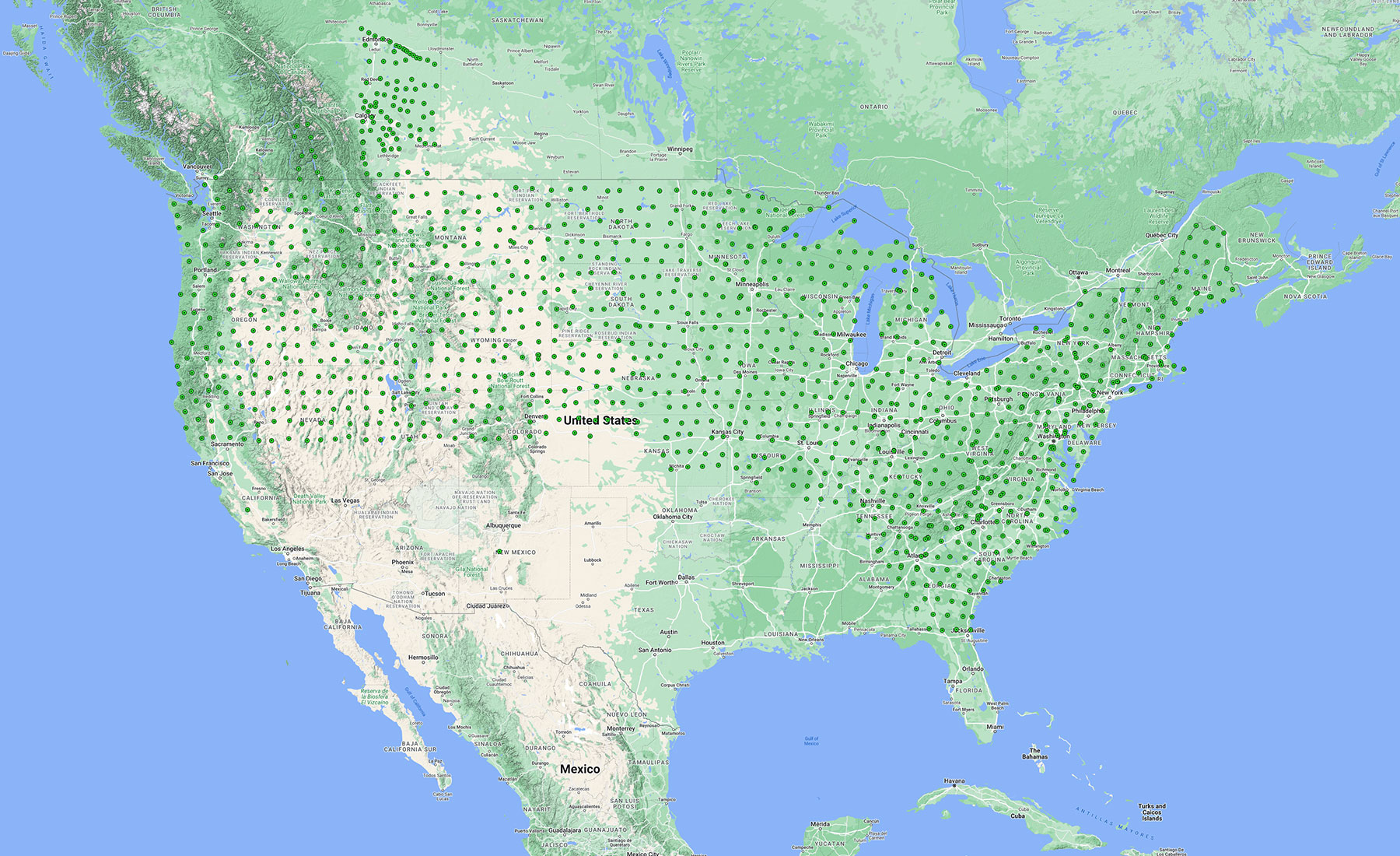
Researchers trained a machine learning model on two months of continuous and simultaneous data output from an array of 25 MT stations in Alaska (US). The trained model effectively predicts geomagnetic effects, with 30 minutes’ advance notice. Fortunately, scaling these forecast abilities to the continental US will not require the long-term operation of thousands of MT stations. The trained model can forecast geomagnetic effects at the 43 miles (70 km) resolution of the full MT Array with significantly fewer permanent stations providing input.
The proposed permanent network is called the “Internet of MT” (IoMT) and would cover the continental US with just 500 permanently installed devices to produce ongoing forecasts, on a grid at 87 mile (140 km) spacing. These devices are designed differently from the equipment at today’s MT Array stations: while collecting the same types of data, they have several advantages. Powered by solar panels and allowing data to be uploaded automatically through a mobile network connection, the IoMT devices have a smaller footprint and a much lower cost of acquisition — approximately $5,000 per station (in contrast to current MT Array station equipment, which would cost $60,000 to install permanently).
The MT Array has, so far, been financed through funding from various US government agencies, including the National Science Foundation (NSF), the National Aeronautics and Space Administration (NASA), and the United States Geological Survey (USGS). Though the IoMT’s equipment design promises a significantly lower cost of acquisition and installation than the technology used in today’s temporary array, funding for this next phase has not yet been secured.
Detailed geomagnetic forecasts could make it possible for grid operators to take proactive steps to protect their infrastructure — preventing prolonged power outages and sparing their customers (including data centers) damaging secondary effects. The predictions offered through the IoMT provide a model that could be used worldwide to address the risks inherent in the threat of geomagnetic EMP. Though it is too early to anticipate how this data could be distributed to data center operators, the value of proactive defense from GMDs may support a subscription service — for instance, on the part of companies that provide weather data.