

• Link to X
  • Link to LinkedIn
  • Link to Mail
  • ABOUT UI
    • Business Partners
    • Careers
    • Contact Us
    • News & Press
    • Our Team
    • Press Releases
    • Branding Guidelines
  • CONTACT
Uptime Institute Blog
  • Journal
    • Journal Home
    • Executive
    • Operations
    • Design
  • AI Services
    • AI Infrastructure Advisory
  • Tier Certification
    • Overview
    • Design
    • Construction
    • Operations
    • Tier Gap Analysis
    • Prefabricated/Modular
    • Tier Certifications List
  • Professional Services
    • Overview
    • Infrastructure Services
    • Management and Operations Services
    • Energy and Sustainability Services
    • Consulting Services
  • Education
    • Course Details
    • Course Calendar
    • Competency & Confidence Assessments
    • Private Education
    • Graduate Roster
  • Events
    • Industry Events
    • Leadership Events
    • Network Events
  • Network
    • Overview
    • Network Calendar
    • Network Roster
    • Request Corporate Access
    • Request Guest Access
    • Uptime Network Portal
  • Intelligence
  • Clients
    • Client Stories
  • Resources
    • Data Center Industry Surveys
    • Ebooks
    • Journal Blog
    • Product Datasheets
    • Research & Reports
    • Tier Specification Documents
    • Tools
    • Webinars
  • Click to open the search input field Click to open the search input field Search
  • Menu Menu
Blog - Latest News
Mixed resiliency at the edge

Mixed resiliency at the edge

November 17, 2021/in Design, Operations/by Dr. Tomas Rahkonen, Research Director of Distributed Data Centers, Uptime Institute

Many analysts have forecast an explosion in demand for edge data centers. After a long, slow start, demand is beginning to build, with small, prefabricated and mostly remotely operated data centers ready to be deployed to support a varying array of applications.

There are still many uncertainties surrounding the edge market, ranging from business models to ownership, and from numbers to types of deployment. One open question is how much resiliency will be needed, and how it will be achieved.

While on-site infrastructure redundancy (site-level resiliency) remains the most common approach to achieving edge data center resiliency, Uptime Institute’s research shows increased interest in software- and network-based distributed resiliency. Nine of 10 edge data center owners and operators believe it will be very or somewhat commonly used in two to three years.

Distributed resiliency, which involves synchronous or asynchronous replication of data across multiple sites, has, until recently, mainly been used by large cloud and internet service providers. It is commonly deployed in cloud availability zones and combined with site-level resiliency at three or more connected physical data centers.

While site-level redundancy is primarily a defense against equipment faults at a site, distributed resiliency can harden against major local events or sabotage (taking out a full site). It can also reduce infrastructure costs (by reducing site-level redundancy needs) and provide increased business agility by flexible placement and shifting of IT workloads. Edge data centers making use of distributed resiliency are connected and operated in a coordinated manner, as illustrated in Figure 1. The redundant element in this case is at least one full edge data center (not a component or system). When a disruption occurs, when capacity limitations are reached, or when planned maintenance is required, some (or all) of the IT workloads in an edge data center will be shifted to one or more other edge data centers.
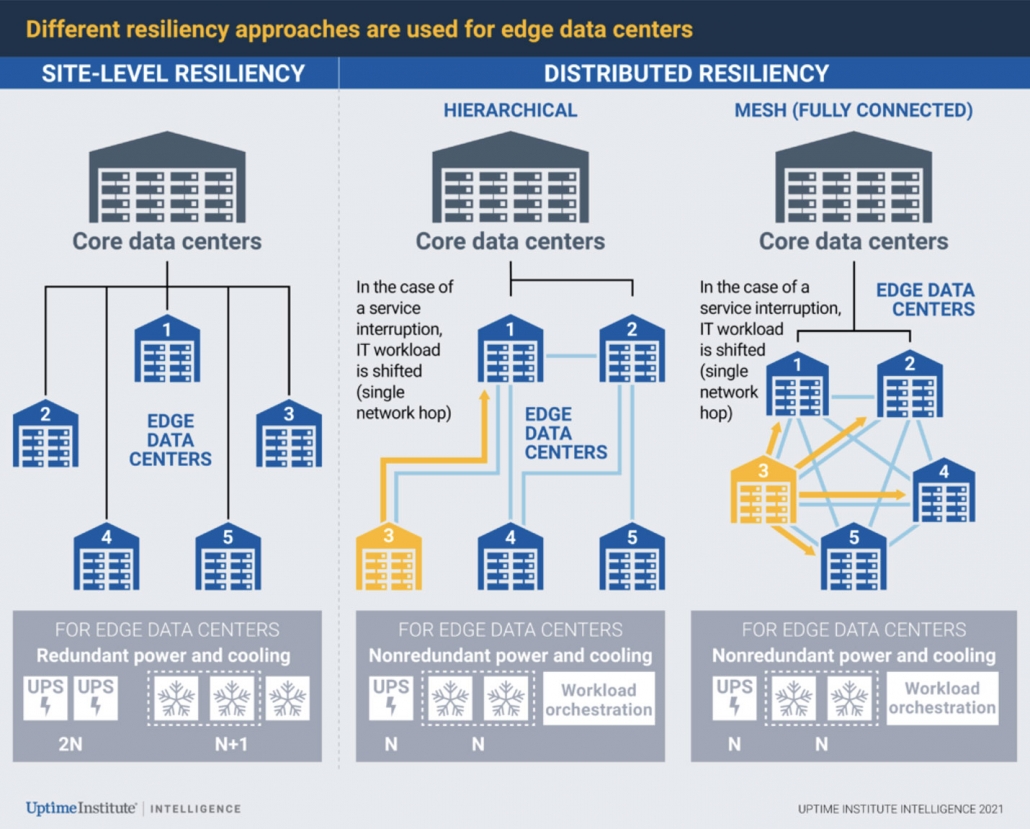
diagram: Different resiliency approaches are used for edge data centers
Figure 1. Different resiliency approaches are used for edge data centers

Site-level resiliency relies on redundant capacity components (also including major equipment) for critical power, cooling, and network connectivity — the approach widely adopted by almost all data centers of any size. Edge data centers using only site-level resiliency tend to run their own IT workloads independently from other edge data centers.

Edge data centers making use of distributed resiliency are connected and operated in a coordinated manner, commonly using either a hierarchical topology or a mesh topology to deliver multisite resiliency.

None of these approaches or topologies are mutually exclusive, although distributed resiliency creates opportunities to reduce component redundancy at individual edge sites without risking service continuity.

Uptime Institute’s research suggests that organizations deploying edge data centers can benefit from the combined use of site-level resiliency and distributed resiliency.

Organizations deploying distributed resiliency should expect some challenges before the system works flawlessly, due to the increased software and network complexity. Because edge data centers are typically unstaffed, resilient remote monitoring and good network management/IT monitoring are essential for early detection of disruption and capacity limitations, regardless of the resiliency approach used.

Share this:

  • Share on Facebook (Opens in new window) Facebook
  • Share on X (Opens in new window) X
  • Share on LinkedIn (Opens in new window) LinkedIn
  • Share on Reddit (Opens in new window) Reddit
  • Share on WhatsApp (Opens in new window) WhatsApp
  • Email a link to a friend (Opens in new window) Email
Tags: Data Center, Data Center Management, Edge Data Center, Resiliency
https://journal.uptimeinstitute.com/wp-content/uploads/2021/11/Mixed-Resiliency-Edge-featured.jpg 628 1200 Dr. Tomas Rahkonen, Research Director of Distributed Data Centers, Uptime Institute https://journal.uptimeinstitute.com/wp-content/uploads/2022/12/uptime-institute-logo-r_240x88_v2023-with-space.png Dr. Tomas Rahkonen, Research Director of Distributed Data Centers, Uptime Institute2021-11-17 08:00:002021-11-16 09:07:48Mixed resiliency at the edge
You might also like
Moscow State University Meets HPC Demands
Extreme Weather and Digital InfrastructureUI 2021 Extreme cold — a neglected threat to availability?
ENTEL Achieves Uptime Institute Tier Certification of Operational Sustainability
US operators scour Inflation Reduction Act for incentives US operators scour Inflation Reduction Act for incentives
How Edge Computing Is Transforming IT Infrastructure
Quantum Computing Quantum computing is not a panacea yet
2020 Will the pandemic accelerate the move to public cloud?
Is Google a credible enterprise cloud? Is Google a credible enterprise cloud?

Content Categories

  • Journal Home
  • Executive
  • Operations
  • Design

Subscribe to Journal via Email

Enter your email address to subscribe to Uptime Institute Journal and receive notifications of new articles by email.

  • Recent

Tags

Accredited Tier Designer (9) AI (21) artificial intelligence (16) ATD (10) Carbon Emissions (7) Climate Change (13) Cloud (22) Cloud Computing (17) Cloud Costs (15) Cloud Infrastructure (29) Cloud Migration (8) Colocation (6) cooling (9) Data Center (252) Data Center Availability (40) Data Center Cooling (13) Data Center Design (45) Data Center Disaster Recovery (7) Data Center Energy Efficiency (34) Data Center Facilities Management (43) Data Center Operations (66) data center power (8) Data Center Staffing (18) DCIM (9) digital Infrastructure (117) energy (8) Energy Efficiency (38) Environmental Sustainability (18) IT (7) IT Efficiency (16) IT Outages (10) M&O (6) outages (11) Public Cloud (7) PUE (10) Regulations (24) Resiliency (9) security (7) Sustainability (34) Sustainability Reporting (7) Tier Certification (26) Tier Certification Constructed Facility (16) Uptime Institute FORCSS (6) Uptime Institute Network (13) Uptime Institute Symposium (6)
© 2014-2025 Uptime Institute, LLC All rights reserved.
  • Link to X
  • Link to LinkedIn
  • Link to Mail
Link to: Does the spread of direct liquid cooling make PUE less relevant? Link to: Does the spread of direct liquid cooling make PUE less relevant? Does the spread of direct liquid cooling make PUE less relevant?Does the spread of direct liquid cooling make PUE less relevant? Link to: Climate change: More operators prepare to weather the storms Link to: Climate change: More operators prepare to weather the storms Climate change: More operators prepare to weather the stormsClimate change: More operators prepare to weather the storms
Scroll to top Scroll to top Scroll to top