• Link to X
  • Link to LinkedIn
  • Link to Mail
  • ABOUT UI
    • Business Partners
    • Careers
    • Contact Us
    • News & Press
    • Our Team
    • Press Releases
    • Branding Guidelines
  • CONTACT
Uptime Institute Blog
  • Journal
    • Journal Home
    • Executive
    • Operations
    • Design
  • AI Services
    • AI Infrastructure Advisory
    • AI Custom Support
  • Tier Certification
    • Overview
    • Design
    • Construction
    • Operations
    • Tier Gap Analysis
    • Prefabricated/Modular
    • Tier Certifications List
  • Professional Services
    • Overview
    • Infrastructure Services
    • Management and Operations Services
    • Energy and Sustainability Services
    • Consulting Services
  • Education
    • Course Details
    • Course Calendar
    • Competency & Confidence Assessments
    • Private Education
    • Graduate Roster
  • Events
    • Industry Events
    • Leadership Events
    • Network Events
  • Network
    • Overview
    • Network Calendar
    • Network Roster
    • Request Corporate Access
    • Request Guest Access
    • Uptime Network Portal
  • Intelligence
  • Clients
    • Client Stories
  • Resources
    • Data Center Industry Surveys
    • Ebooks
    • Journal Blog
    • Product Datasheets
    • Research & Reports
    • Tier Specification Documents
    • Tools
    • Webinars
  • Click to open the search input field Click to open the search input field Search
  • Menu Menu
Blog - Latest News
Direct liquid cooling bubbles to the surface

Direct liquid cooling bubbles to the surface

March 31, 2022/in Design, Executive, Operations/by Lenny Simon, Senior Research Associate, Uptime Institute

Conditions will soon be ripe for widespread use of direct liquid cooling (DLC) — a collection of techniques that uses fluid to remove heat from IT electronics instead of air — and it may even become essential.

Currently, air cooling is still dominant with DLC remaining a niche option — around 85% of enterprise IT operations do not use it at all, according to Uptime Institute Intelligence’s recent Direct Liquid Cooling Survey of nearly 200 enterprises. About 7% of respondents to our survey report some application of DLC, such as in mainframes or a few racks, and this leaves only 9% that use DLC in more substantial ways.

Despite the current low uptake, Uptime Intelligence expects this view to shift markedly in favor of DLC in the coming years. In Uptime Intelligence’s survey, nearly two-thirds of enterprise IT users would consider it as a future option (see Figure 1).
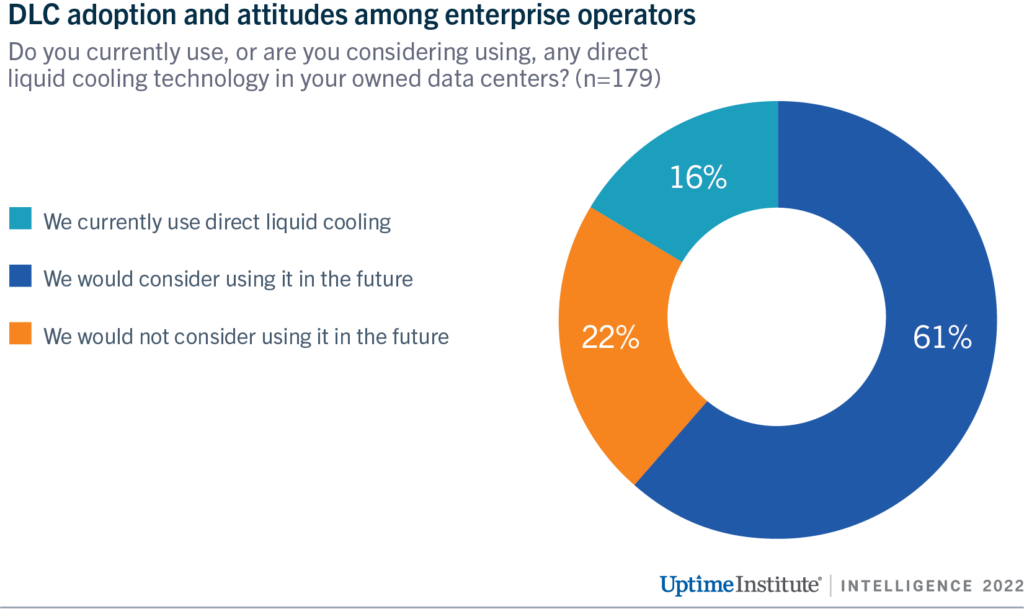
diagram: DLC adoption and attitudes among enterprise operators
Figure 1 DLC adoption and attitudes among enterprise operators

Why would operators consider such a major change beyond select use cases? A likely key factor is silicon power density: the heat flux and temperature limits of some next-generation server processors and accelerators coming to market in 2022 / 2023 will push air cooling to its limits. Processors with thermal ratings of 300 watts and above — some with steeply lowered temperature limits — are on the short-term roadmap. To keep up with future advances in silicon performance, while also meeting cost and sustainability goals, air cooling alone could become inadequate surprisingly soon.

Industry body ASHRAE has already issued a warning in the form of adding a new H1 class of high-density IT equipment in its most recent update to its data center thermal guidelines. (See New ASHRAE guidelines challenge efficiency drive.) Class H1 equipment, classified as such by the server maker, require inlet temperatures of under 22°C (71.6°F), well under the recommended upper limit of 27°C (80.6°F) for general IT equipment. Many modern data center designs operate at temperatures above 22°C (71.6°F) to lower cooling energy and water consumption by minimizing the use of compressors and evaporation. Lowering temperatures (which may not be possible without a major overhaul of cooling systems) to accommodate for class H1 equipment would frustrate these objectives.


Collectively, the data center industry considers the use of DLC to be not a question of if, but when and how much. Most enterprises in our survey expect at least 10% of their cabinets to have DLC within five years. A previous Uptime Institute survey supports this data, showing that for data centers with an IT load of 1 megawatt or greater, the industry consensus for mass adoption of DLC is around seven years. Only a few respondents think that air cooling will remain dominant beyond 10 years. (See Does the spread of direct liquid cooling make PUE less relevant?)

Today, there is no single DLC approach that ticks all boxes without compromises. Fortunately for data center operators, there has been rapid development in DLC products since the second half of the 2010s, and vendors now offer a wide range of choice with very different trade-offs. Our survey confirms that cold plates using water chemistries (for example, water that is purified, deionized or a glycol mix) is the most prevalent category. However, there are still significant concerns around leakage among survey participants, which can curb an operator’s appetite for this type of DLC when it comes to large-scale installations.


Other options include:

  • Cold plates that circulate a dielectric fluid (either single-phase or two-phase) to reduce the risks associated with a leak.
  • Chassis-based immersion systems that are self-contained (single-phase).
  • Pool immersion tanks (also either single-phase or two-phase).

Nonetheless, major hurdles remain. There are some standardization efforts in the industry, notably from the Open Compute Project Foundation, but these are yet to bear fruit in the form of applicable products. This can make it difficult and frustrating for operators to implement DLC in their data centers, let alone in a colocation facility — for example, different DLC systems use different, often incompatible, coolant distribution units. Another challenge is the traditional division between IT and facilities teams. In a diverse and large-scale environment, DLC requires close collaboration between the two teams (including IT and facility equipment vendors) to resolve mechanical and material compatibility issues, which are both still common.

Despite the challenges, Uptime Institute maintains a positive view of DLC. As the demands on cooling systems grow with every generation of silicon, operators will find the advantages of DLC harder to ignore. We will explore various DLC options and their trade-offs in a subsequent Uptime Intelligence report (due to be published later in 2022).

Share this:

  • Share on Facebook (Opens in new window) Facebook
  • Share on X (Opens in new window) X
  • Share on LinkedIn (Opens in new window) LinkedIn
  • Share on Reddit (Opens in new window) Reddit
  • Share on WhatsApp (Opens in new window) WhatsApp
  • Email a link to a friend (Opens in new window) Email
Tags: Data Center, DLC, Emerging Technologies, Environmental Sustainability, Liquid Cooling, Operations & Procedures
https://journal.uptimeinstitute.com/wp-content/uploads/2022/03/DLC-direct-liquid-cooling-featured.jpg 628 1200 Lenny Simon, Senior Research Associate, Uptime Institute https://journal.uptimeinstitute.com/wp-content/uploads/2022/12/uptime-institute-logo-r_240x88_v2023-with-space.png Lenny Simon, Senior Research Associate, Uptime Institute2022-03-31 06:00:002022-03-29 16:39:28Direct liquid cooling bubbles to the surface
You might also like
Long shifts in data centers — time to reconsider? Long shifts in data centers — time to reconsider?
Cloud SLAs punish, not compensate Cloud SLAs punish, not compensate
AI and cooling: toward more automation AI and cooling: toward more automation
Business Outages Why do some industries and organizations suffer more serious, high profile outages than others?
Data Center Cooling: CRAC/CRAH redundancy, capacity, and selection metrics
ASHRAE Guidelines New ASHRAE guidelines challenge efficiency drive
The majority of enterprise IT is now off-premises The majority of enterprise IT is now off-premises
Pay As You Go IT Infrastructure2020 Pay-as-you-go model spreads to critical components

Content Categories

  • Journal Home
  • Executive
  • Operations
  • Design

Subscribe to Journal via Email

Enter your email address to subscribe to Uptime Institute Journal and receive notifications of new articles by email.

  • Recent

Tags

Accredited Tier Designer (9) AI (21) artificial intelligence (16) ATD (10) Carbon Emissions (7) Climate Change (13) Cloud (22) Cloud Computing (17) Cloud Costs (15) Cloud Infrastructure (29) Cloud Migration (8) Colocation (6) cooling (9) Data Center (252) Data Center Availability (40) Data Center Cooling (13) Data Center Design (45) Data Center Disaster Recovery (7) Data Center Energy Efficiency (34) Data Center Facilities Management (43) Data Center Operations (66) data center power (8) Data Center Staffing (18) DCIM (9) digital Infrastructure (117) energy (8) Energy Efficiency (38) Environmental Sustainability (18) IT (7) IT Efficiency (16) IT Outages (10) M&O (6) outages (11) Public Cloud (7) PUE (10) Regulations (24) Resiliency (9) security (7) Sustainability (34) Sustainability Reporting (7) Tier Certification (26) Tier Certification Constructed Facility (16) Uptime Institute FORCSS (6) Uptime Institute Network (13) Uptime Institute Symposium (6)
© 2014-2025 Uptime Institute, LLC All rights reserved.
  • Link to X
  • Link to LinkedIn
  • Link to Mail
Link to: Data center operators ponder the nuclear option Link to: Data center operators ponder the nuclear option Data center operators ponder the nuclear optionData center operators ponder the nuclear option Link to: Why cloud is a kludge of complexity Link to: Why cloud is a kludge of complexity Cloud ComplexityWhy cloud is a kludge of complexity
Scroll to top Scroll to top Scroll to top